


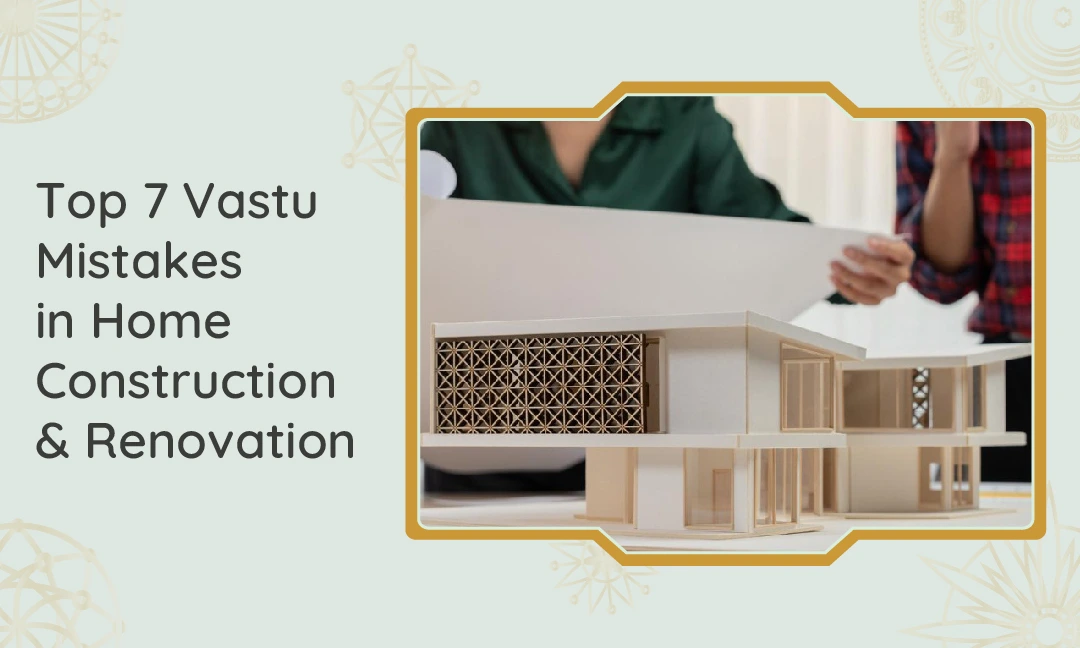
Are you worried about unknowingly committing certain Vastu mistakes while constructing your new house? Even simple factors such as plot orientation, room placement, and entrance direction can easily disturb the energies in your house. This blog aims to explain even the minute details regarding the floor levels, slope and colours that invite both harmony and prosperity. The tips mentioned in this blog aren’t just practical but easy to implement as well. Along with tips to follow, we’ve also mentioned the mistakes you need to avoid for a new house construction. Apply these principles to build a space that supports harmony, healthy airflow, and a thriving living environment.
A] Ignoring Plot Orientation and Directions – Mistake #1
Plot Direction Errors
A common mistake many homeowners make is selecting a plot without considering the direction. East/northeast-facing plots are ideal. North is secondary for wealth. The east, however, is ideal for new beginnings and growth. Northeast corner for the pooja room, regardless of plot facing. To find more insights, we recommend enrolling in our foundational Vastu Shastra course.
Suggested Approach
South- and west-facing plots can be harder to navigate, but certain adjustments can balance the energies. If the plot is west-facing, the addition of verandas or trees can help to balance the heavy energy. The addition of trees is even advisable for south-facing plots. Simple tips like observing the direction in which the sunlight follows can prove useful. Even minor details, such as the way wind flows, can help the fresh air circulate freely.
B] Incorrect Room Placement – Mistake #2
Common Errors To Avoid
Assigning rooms without understanding elemental balance can lead to an energy imbalance. The kitchen represents the fire (Agni) element. Placing it in the northeast (water zone) creates elemental conflict, leading to restlessness and health issues. The same can be said for the master bedroom. Troubles such as irritability, disturbed sleep, or tension in relationships can be noticed. Constructing toilets in this zone is another major mistake that you can make. This is because it can increase feelings of mental stress.
Vastu-aligned Guidance
Some minor tweaks ensure that each room contributes to the overall harmony. To start with, the kitchen can be placed in the southeast direction. This is because the kitchen represents Agni, a source of vitality and nourishment. For the master bedroom, the southwest can help to support a restful sleep. For the living room, the northeast can be preferred, as it represents movement and positivity. All these Vastu tips for new house construction contribute positively in the long run.
C] Entrance Placement Without Directional Clarity – Mistake #3
Entrance Direction Errors
The main entrance is often described as the gateway of energy. Instead of choosing the main door location based on aesthetics, directions should be considered. The southwest direction in particular should be avoided to maintain a stable energy flow. Be sure that this entrance is not blocked by any shoe racks or other storage units. Also, avoid entrances that align with staircases or windows. This is because they can cause the energy to move outward. Make sure the entrance is well-lit as well.
Vastu Guidance
Avoiding direction-based guidance for the main entrance could lead to an energy imbalance. Southwest is the least favourable direction for your entrance. The main door should ideally be the largest door in the house and not have anything that obstructs it. Also, be sure that the frame is complete on all 4 sides. It is beneficial if the entrance has an open space towards it. For more tips, refer to this blog on the main door Vastu Shastra.
D] Overlooking Levels, Slopes, And Floor Heights – Mistake #4
Elevation & Slope Problems
Uneven floor heights or slopes, in certain cases, can even lead to instability, financial strain, or even emotional upheaval. Even a flat slope can create stagnancy. Constructing a basement in the southwest zone can also result in an imbalance of the energies. Any depressions, pits, or underground tanks should also be avoided in this direction. For staircases, start from the southwest and end towards the northeast. Avoid uneven flooring if possible.
Recommended Approach
Ideally, the height in the south and west needs to be higher than the north and east. This allows for better grounding. Even for a slope, southwest should be at a higher elevation than northeast. This allows water to flow naturally toward the northeast. Slopes in the reverse direction need to be avoided. In the case of basements, tanks or pits, go for a north or east direction. Overhead water tanks do well in a southwest direction. A quick Vastu tip for your house construction is redoing the flooring in its natural direction.
E] Excessive Structural Changes During Renovation – Mistake #5
Renovation Errors To Avoid
Avoid heavy or low false ceilings in the north/east, as they trap negative energy and disrupt the space element; opt for open, light designs elsewhere. Even the use of heavy materials such as marble and granite should be avoided. Decorative beams and other boxed ceiling structures should be kept to a minimum. For stable energy, large windows can be replaced with smaller ones. Use of open verandas is always encouraged. If any roof slabs need to be extended in the northeast, be sure it is done while carefully balancing their weight.
Vastu-Aligned Renovation Tip
Intentional changes allow for a better balance in the elements. For instance, if the ceilings need to be lowered, the design should be kept minimal. Also, heavier ceilings are more suitable in the south and west directions. If the use of heavy materials is to be done, make sure the weight is distributed evenly. Avoid any heavy pillars or unnecessary storage in the northeast corner. It’s not advisable to do sudden height reductions as well. Verandas should ideally remain open-sided to maximise sunlight and airflow.
F] Choosing Wrong Colours And Ignoring Directions – Mistake #6
What To Avoid
Use of dark colours such as brown, maroon, or charcoal grey is discouraged. The same rules apply to your ceiling colour as well. Even bright colours such as bright red or bright orange can disrupt a calm environment. The opposite of these, washed tones, can be skipped as well. Even the direction of sunlight could be considered. For instance, cool colours work better for north-facing rooms, while warm shades work well with south-facing rooms. Instead of following trends, go for a long-term-focused approach.
A Better Practice
Understanding the direction of your room will help in the colour selection. With northeast soft pastel colours can do the trick. For the south and west, earthy colours can promote a grounding effect. Use of reflective colours can also serve the same purpose. For bedrooms, the use of calm colours instead of sharp contrast is considered beneficial. A gradual flow of colours is always recommended. Another Vastu tip you can follow while building a new house is to test the colour in natural light.
G] Treating Vastu As A Rigid Rulebook – Mistake #7
Treating Vastu As A Checklist
Applying all these Vastu rules for new house construction doesn’t have to be done mechanically. The approach should be adaptive instead of rigid. Every change is to be led by a reason or principle. Even expensive structural alterations cannot give proper results if done improperly. Elements such as the layout cannot be based on isolated elements. At the end, every home differs in its plot orientation and other structural elements. Directional awareness should be the first stage and not an afterthought.
Vastu-Aligned Approach
At the end, Vastu is based on a system of spatial intelligence. Elements such as the light, weight distribution, and airflow need to be considered. Focus should always be on supportive zones. Again, not all changes require demolition, relocation or a fear-based approach. Prioritising natural light and structured stability is always recommended. Advice from experts provides better results in most cases.
Have you faced Vastu issues in your space?
Get an instant solution for your Vastu issues and make your space Vastu-compliant.
Conclusion
By now, we’re sure you’ve attained a better understanding of all the tips you could use for your new house construction. When the construction of a new house is properly planned, one can notice gradual changes over time. Benefits such as enhanced spatial ability and improved daily functioning often become prominent with a structured approach. By contacting Vastu Shastra experts, accurate architectural insights can be achieved. Find practical solutions that focus on holistic planning through Vastu Shastra. Attaining long-term stability is not difficult with Vastu Shastra.

Vastu Acharaya Geetanjali Bhalla
Greetings, I'm Geetanjali Bhalla your Vastu Consultant serving UK since 2008. I am passionate about blending ancient wisdom with modern living, I specialize in creating harmonious spaces tailored to your unique needs. Let's work together to infuse positivity and abundance into your surroundings using Vastu Shastra and Vedic Astrology. Need help making decisions that align with your goals? Contact us, and let's transform your space!
Embark on a Vastu Shastra course to improve your quality of life and well-being, and see an increase in the positivity of your mindset.
Address
Northwood in the Greater
London Area
London Area
Email : ask@vastu-shastra.co.uk
Call Us : +44 (0) 203 393 0444
Copyright © 2026 Vastushastra. All Rights Reserved. Made By Capsicum.